
Why Forklift Safety Training Matters: Compliance and Productivity in Singapore
Forklifts are essential to daily operations in warehouses, logistics centres, manufacturing plants, construction sites, and distribution hubs across Singapore. These machines improve efficiency, speed, and productivity—but without proper operator training, they can also introduce significant safety risks.
Under the Ministry of Manpower (MOM), forklift training is not optional. It is a legal requirement. This guide explains why proper forklift training matters, the latest MOM mandates, and how trained operators contribute to safer and more efficient workplaces.
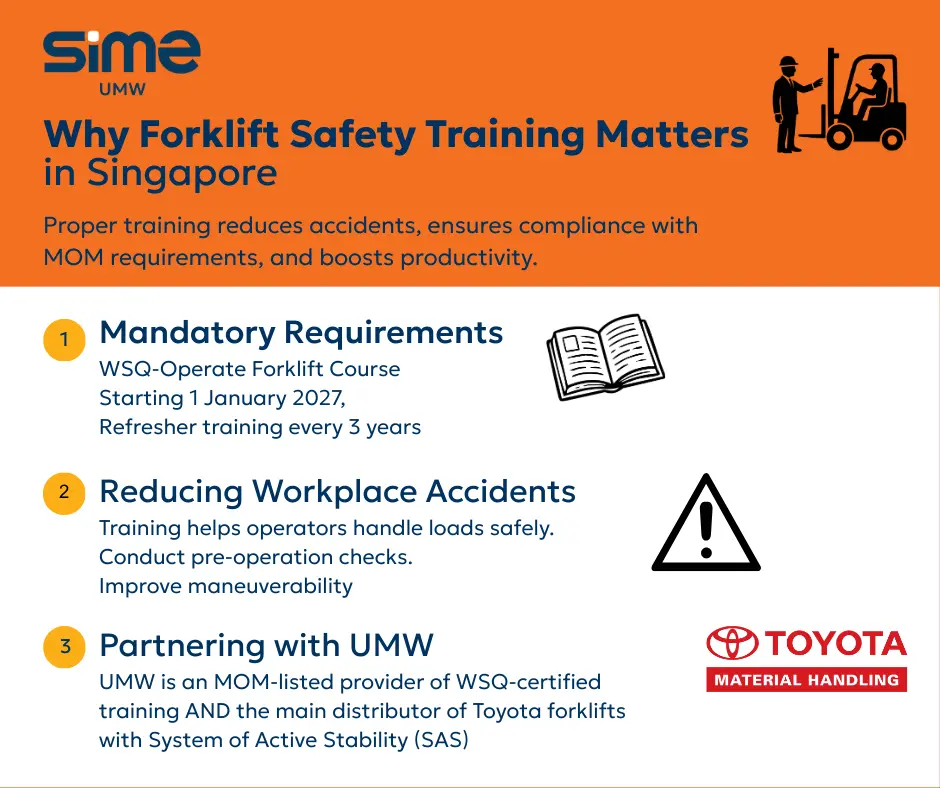
1. MOM Regulations: What Every Business Must Know
In Singapore, all forklift operators must hold a recognised certification before they are allowed to operate a forklift. This requirement ensures operators are competent, safe, and compliant with national safety standards.
WSQ Operate Forklift Course (Mandatory)
The Workforce Skills Qualifications (WSQ) Operate Forklift Course is the industry-recognised certification jointly developed with:
- SkillsFuture Singapore (SSG)
- Ministry of Manpower (MOM)
- Workplace Safety and Health Council (WSHC)
More info: https://tinyurl.com/3rwhm63m
Mandatory Refresher Training (Starting 1 January 2027)
Under the new MOM circular released in January 2025, all certified operators must undergo a refresher training course every 3 years.
Circular link: https://tinyurl.com/9s3unr7k
This initiative ensures operators stay up-to-date with safety practices, equipment knowledge, and hazard awareness—especially important as workplaces become more complex and equipment becomes more advanced.
2. Reducing Workplace Accidents
Forklift-related incidents remain a concern in Singapore. MOM has cited “concerning statistics” as one of the reasons behind strengthening mandatory refresher requirements.
Source: https://tinyurl.com/2r759872
Common forklift hazards include:
- Tip-overs caused by improper load handling
- Collisions in narrow or congested aisles
- Injuries from poor visibility or unsafe manoeuvres
How WSQ training helps prevent accidents:
The WSQ curriculum ensures operators are trained to:
- Assess load stability and handling
- Conduct proper pre-operation safety checks
- Navigate and manoeuvre safely in various environments
- Reinstate, park, and hand over forklifts responsibly
These competencies reinforce correct operating behaviour and significantly reduce workplace risks.
3. Boosting Productivity Through Skilled Operators
Forklift training isn’t just about compliance—it is also an operational advantage. Skilled operators:
- Improve loading accuracy
- Reduce product damage and handling errors
- Minimise equipment misuse
- Lower downtime caused by avoidable accidents or breakdowns
The WSQ training outcomes equip operators with systematic approaches that enhance overall workplace efficiency while protecting valuable assets.
4. Best Practices for Maintaining Forklift Safety
To maintain a safe and productive environment, businesses should adopt the following practices:
✔ Conduct compulsory refresher courses every 3 years
Aligned with MOM’s updated requirement starting in 2027.
✔ Enforce daily pre-operation checks
A key WSQ competency that prevents mechanical failures.
✔ Establish safe movement zones
Clear traffic routes and pedestrian walkways reduce collision risks.
✔ Use visual safety communication
Signage, floor markings, and hazard labels improve operator awareness and compliance.
When combined, these practices create a proactive safety culture.
5. Partnering with the Right Experts
Working with a qualified training provider ensures training is conducted according to MOM and SSG standards.
UMW Equipment & Engineering Pte Ltd is listed in the MOM training provider directory and offers professional forklift training aligned with WSQ requirements.
As the main distributor of Toyota, BT, and Raymond material-handling equipment, UMW brings decades of industry expertise. Toyota forklifts are particularly valued for their System of Active Stability (SAS)—a unique safety technology designed to reduce tip-overs and enhance stability during operations. These advantages make Toyota a trusted choice for many Singapore businesses.
Final Thoughts
Forklift safety training in Singapore is both a legal obligation and a strategic investment. By ensuring operators are properly trained and refreshed regularly, companies can:
- Protect their workforce
- Reduce workplace risks
- Avoid regulatory penalties
- Improve overall productivity and efficiency
Proper forklift training remains one of the most cost-effective ways to build a safer, smarter, and more resilient operation